An Unbiased Guide to Selecting a Heat Pump Water Heater for Your Home
KEY TAKEAWAY
Look for a heat pump water heater of UEF 3.3 or higher, Wi-Fi or CTA-2045 connectivity, and a thermostatic mixing valve. Select a tank size based on the number of rooms in your home (not occupancy, which can change over time). Avoid electrical panel upgrades to minimize cost and project delays.
In this article, you’ll find:
Replacing a gas water heater with a heat pump water heater is one of the most impactful home improvements for healthier air quality, reducing energy waste, and lower energy bills. As the most energy-efficient water heaters on the market, and with rebates and incentives available, heat pump water heaters are a beneficial option for many homes.
What should you consider when selecting the right heat pump water heater for your home? This article provides an unbiased guide.
Features to look for in a heat pump water heater
We recommend considering the following when choosing a heat pump water heater:
- Efficiency: Look for a Uniform Energy Factor (UEF) of 3.3 or above. This number represents how efficiently the unit operates, and the higher the better. Additionally, the Northwest Energy Efficiency Alliance (NEEA) rates products by performance—look for a unit rated as Tier 3 or 4 for better performance and lower noise.
- Connectivity: Look for a “smart” heat pump water heater that is connectable either through Wi-Fi or CTA-2045. This allows syncing your water heater to hourly utility rates to heat water when electricity is cheapest.
- Thermostatic Mixing Valve: This allows water in the tank to be stored at a higher temperature (140° F) and blended with a small amount of cold water to provide the desired temperature (typically 120° F). Each additional degree the water is heated in the tank provides the equivalent of one extra gallon of storage capacity, making sure there’s always plenty of hot water. Including a thermostatic mixing valve is also a requirement for many incentive programs.
Heat pump water heater tank size guidelines
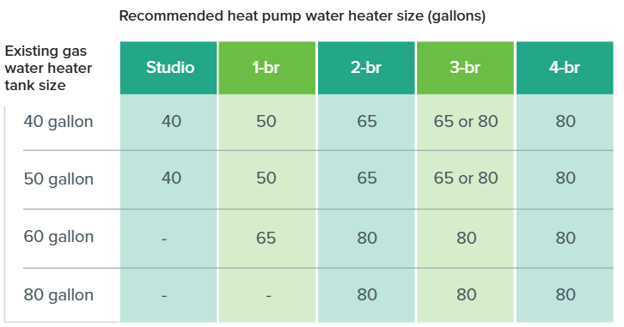
If you plan to replace a gas water heater with a heat pump water heater, consider upsizing the tank. While heat pumps are more efficient, they take longer to heat up. A bigger tank reduces the chance that you will run out of hot water.
Water heater sizing should be based on characteristics of the home (e.g. number of bedrooms) rather than occupancy, which can change over time.
Consider also including a thermostatic mixing valve for additional heat capacity to ensure there’s always plenty of hot water.
Always consult a licensed contractor or equipment manufacturer before purchasing a system to make sure the selection suits your needs.
The table below provides recommended heat pump water heater size for 240V systems. For 120V plug-and-play systems, increase to the next available system size.
Will a larger heat pump water heater fit in my space?
For reference, an 80-gallon heat pump water heater is about 2 feet in diameter and needs at least 6.5 feet of ceiling height. For a smaller water heater, consider installing a thermostatic mixing valve.
Avoiding electrical panel upgrades for heat pump water heater
Contrary to popular belief, 90% of Bay Area single-family homes can go all-electric on a 100-amp electrical panel. Many newer 120-volt plug-in models require no new wiring at all.
Below are some recommendations for installing a heat pump water heater without overloading the existing panel. Always consult with a licensed electrician before performing home electrical projects.
|
Situation |
Potential Solution #1 |
Potential Solution #2 |
|
Panel has no remaining capacity (amps) |
Install a circuit sharing device to share the 240V dryer or EV charging circuit |
Install a 120V heat pump water heater on an existing circuit |
|
Panel has no remaining breaker space |
Replace standard breakers with slimline (skinny) breakers |
Have an electrician combine circuits to free up breaker space or install a subpanel |
Install a 240V 15A or a 120V 15A model instead of a 240V 30A model when possible. Avoiding an electrical service upgrade can save thousands of dollars and PG&E project delays that can take 6 to 12+ months.
Support for installing a heat pump water heater
If you already have a contractor or prefer to install a heat pump water heater yourself, reserve your rebate and claim your reimbursement through the SVCE Home Rebates program.
Full-Service Installation and Rebates
Take the hassle out of your installation with the SVCE Full-Service Home Upgrades program. Our pre-vetted contractors will handle your project from start to finish, including a free assessment, installation with warranty, and applying for permits and rebates. Income-qualified residents may even receive a free heat pump water heater and no-cost installation.
It’s cheaper and easier to replace a water heater before it breaks (at the 8 to 10-year mark), but if an emergency comes up, SVCE is here to help. Our Emergency Water Heater service provides same or next-day service to help replace your broken water heater with a heat pump water heater. White-glove support includes pre-vetted contractors, a free assessment, installation with warranty, and applying for permits and rebates.
More Questions or Support?
Our Go Electric Advisors are here to help! Consult our expert advisors via phone, live chat, and email—at no cost to you. Get personalized help with technical questions, compare quotes, and explore incentives.